Arborvitae

Patrick Trombly


The two
by the side
as tall
are swaying
Ma wants to
so they
the snow and
over this
Pop wants them
altogether-
it hasn’t
years.
anything about it.
them the way they’ve
We don’t need sun on
No one ever goes in
not even Paulo,
(and Paulo goes
It’s just odd, the way it
the back room and its
blocked by the
It sticks out so far
kitchen window on the
It is August, and yet
The rain and the wind from the
glass pane rattle and shake
and swing enough to snap.
were planted by Miss Philbert, the old
Before
And they were only three
the house, and
Pop says.
I was born.
the arborvitae were tall enough
the sun has never

That’s
room
they
Miss
you


Author’s Bio: Patrick Trombly’s thesis of Organic Structure conceives of the poem as a living organism that begins as an idea and self-evolves into a unique integration of text, narrative and physical form.  Patrick’s poetry and long fiction have been recently featured in several journals, including Connecticut River Review, 1922 Review, Relief, Resonance and The Dewdrop, and are forthcoming in Lemonwood Quarterly, Alabama Literary Review and Ink in Thirds.   Patrick lives and writes in New York City.


arborvitae
of the house
as the house
in the breeze.
trim them,
won’t break when
ice make them bend
winter.
cut down
let the sun in where
been for many
But he’s too lazy to do
I’d just as soon leave
grown to be.
that side of the house.
that room-
our dog
everywhere).
juts into the garden-
one window,
untended evergreens.
that I can see it from the
other side of the house.
I had to come in from the rain.
cold front make the single
and cause the limbs to twist
The two arborvitae
lady who had the house
us.
feet tall when our family moved in to
that room was not always dark,
That was six years before
But since I can remember,
to cover the window, and
entered that room.

the
where
found
Philbert,
know.



Baba Yaga Encounters the 21st Century

Deidre Cavazzi


I am every body,
and I am none of them.
A forest is a cathedral, is a coffin, is a crucible.

Heavy mist creeping, fingers of fog walking
through my veins until I am earth again,
until I remember that I am clay and story and
promise and aftermath,

that I am gooseflesh breath-prickled
over brittle bones, spruce-tangled hair
clothed in peeling birch skins:

the horror sliding from your tongue,
the telling you tuck behind teeth,
foundation of bones unwindowed.

You, who shiver in the dark
at the thought of my wrinkles and warts
have unleashed more hell on earth
than I ever could have.

My madness was always waltzing
with Nature, as tender, as terrible.

It’s give and take, my dear.

Chicken feet picking through mosses,
the mortar and pestle of me
grinding against earth, riding
one season into the next.

Birth is a death yet to be named,
longing steeped in love and letting go.

Snow always followed
and I picked the bones of winter
out of my teeth, already counting mushrooms

but you, you have made bonfires
out of forests, rivers out of glaciers,

you have killed more little ones than I,
have loosed more nightmares on the night.

You are the true maker of haunted places;
at least my dark woods still run with wolves,
my soil still writhing with worms
and tangled with roots.

My cackle and cry sing truths
while your honeyed voice is still
whispering falsehoods to yesterday.


Author Statement: The folklore of Baba Yaga is steeped in dark woods and darker tales; in many stories she is cunning and terrible, a symbol for death and cruelty. However, her magic is aligned with nature and she works with the seasons and elements. There is great wisdom and reverence for the natural world in her choices, even though we—as the storytellers—often paint her as the villain. In this poem, I wanted to capture both sides of her and also allow her to hold up a mirror to the horrors that we have inflicted on nature through climate change and habitat loss.


Author’s Bio: Deidre Cavazzi can often be found wandering in the redwoods or peering into tidepools in California. Her chapbook, carapace, root & feather, is available through Bottlecap Press, and her writing appears in journals including Soundings East, Polarlit, Rust & Moth, Corpus Callosum, Crow & Cross Keys and Merion West. She has been an artist-in-residence with The Arctic Circle in Svalbard, the Fish Factory Creative Centre in Iceland, and a guest artist at the University of Galway, Ireland.

Road of Bone

Chloe DeVos


I dig my heels into each craggy crack,
And feel icy claws dig into my back.
Shadows dance around me; I’m not alone,
Wandering this road of bone.
Gargoyles watch with crumbling eyes
As I whisper goodbyes
To silver moonbeams, to wilted dreams
I hadn’t the chance to see.
It shouldn’t be so hard to climb
This bumpy white path to the sky;
As I trip on ribs and shove away spines,
What do I want to find—
Charred bits of flesh flaking away,
The remnants of a long-lost day?
Nothing will help me here,
Not even a halo will dry my tears.
I let their cries, low and dull,
Pound away at my skull.


Author's Statement about Piece: "I'm fascinated by everything spooky, and I was inspired by the idea of autumn being a time of death and decay. However, I wanted to turn it into a story—one that felt relevant any time of year.


Bio: Chloe DeVos (she/her) is an emerging author, who has crafted numerous poems and stories throughout her youthful journey. Some of her poetry has been published in local journals, such as the Bluebird and Dahlia Zine. She has also published two short stories. Beyond the realm of writing, Chloe finds solace in the strokes of drawing, the pages of manga, leisurely strolls, and delving into the annals of history. 

the smell of butter

Rowan Waller


I remember the first red stain
it was in the middle of a movie at the
AMC near my house
my little bladder couldn’t handle
the over-sized blue raspberry Icee
so I ran to the popcorn-scented bathroom
to realize I was a woman
I stuffed an entire roll of toilet paper
between my legs and waddled back to my
seat in the dark secretly grateful because
I needed something to complain
about with the other girls at the lunch table
who had to wear bras and shave twice a week
they said men could smell blood
before you even realized
you had any


Author’s Note: This poem was inspired by true events! As a young girl, I developed slower than some of my classmates who hit puberty pretty early on. Middle schoolers can be quite cruel as they try to find their place in the world, and I was often the target of bullying for things I could not control (like when my body would begin menstruation). 

Looking back now, I'm glad I got to enjoy a few more years without monthly cycles, but at the time I was so desperate to fit in that I wanted to be in pain like the other girls. I was in such a rush to grow up without realizing all the complications and dangers that womanhood entailed, hinted at by the poem's final lines "...men could smell blood | before you realized | you had any.”


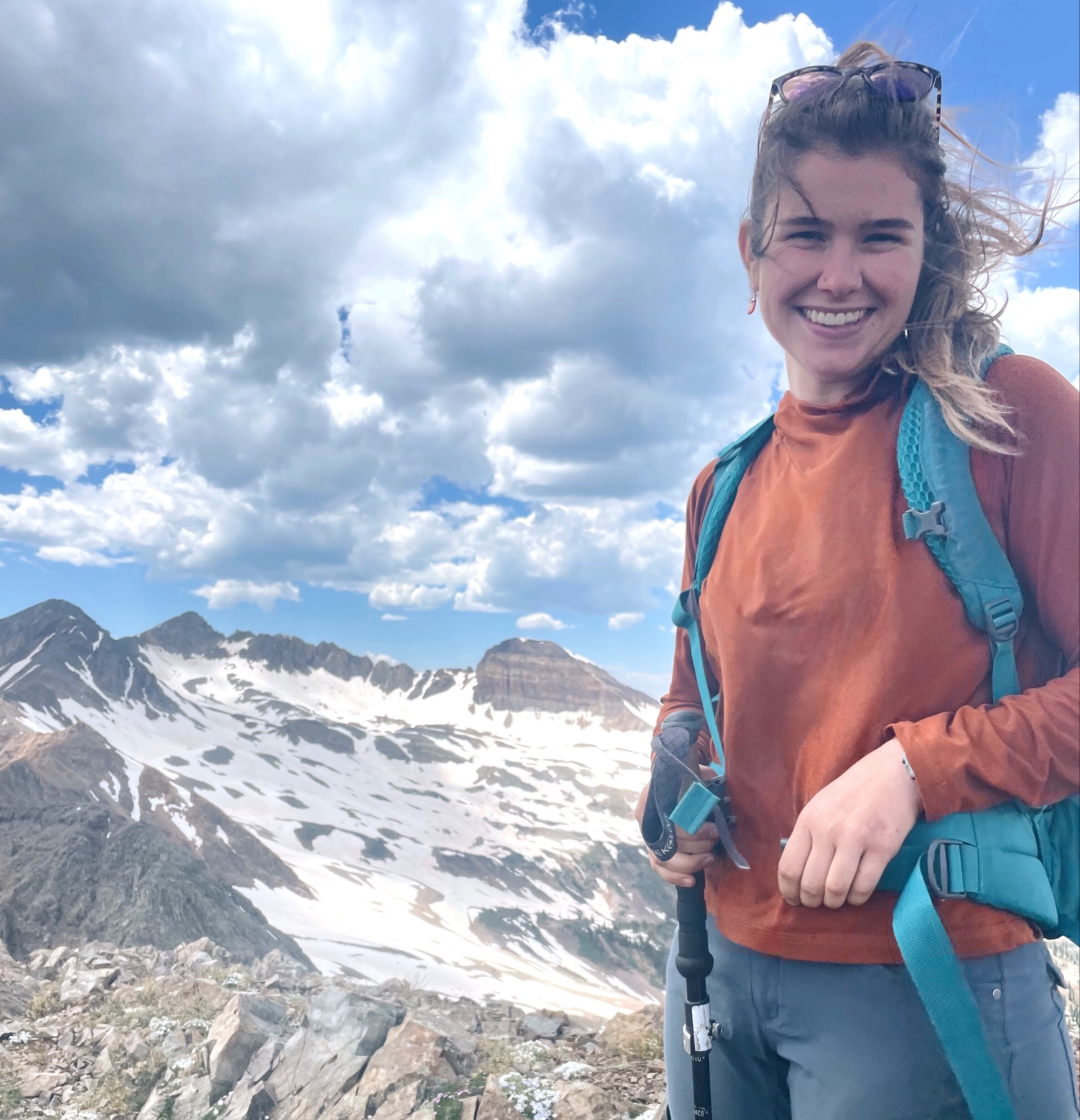
Rowan Waller is an educator, rock climbing guide, and Emergency Medicine student based in Durango, Colorado. She spends most of her time working with learners of all ages in the San Juan Mountains and loves giving back to her community any way she can. When she isn't working, she can be found writing about a childhood spent growing up in the southern plains, dreaming up big climbing adventures to go on, or running with her rescue dog "Oatmeal". 

Hermes Takes it Easy

Bill Glose

Once, nothing was more important than speed.
Faster than Zeus’s bolts, Hermes played tricks

on the naked eye—altering arrows mid-flight,
stealing jewelry from a maiden’s neck,

nudging sundials so shadows spun backwards.
But the sprint of time has become a marathon,

and comforts once eschewed
now surround him in plush wonder.

Why run to the store when an App
brings deliveries to your door?


Kicked back in a La-Z-Boy,
winged sandals shoved beneath,

Hermes rests a bowl of chili fries
on the mound of his belly,

surfing channels in search of The Bachelor.
It’s the first episode of a new season

and all the Muses arrive in stretch limos,
their spiked heels clicking up the walkway,

whitened teeth gleaming, every mouth
perfect as the one before.


Whenever possible, Bill Glose undertakes intriguing pursuits to write about for magazines, such as walking across Virginia and participating in a world-record-setting skinny dip. The author of six poetry collections, one book of fiction, and hundreds of articles, Bill Glose was featured by NPR on The Writer’s Almanac in 2017 and won the Library of Virginia Award for Fiction in 2023.

Who I Am at the End of the World

Sascha Cohen


Here I am, boys—revived,
back from the brink, resuscitated
and revitalized. My blonde hair, buoyant.
My new breasts, pneumatic.

You wouldn’t know it
but something survived in the Titan
submersible of my body. Now I’m
cyborg acrylic and silicone. Now I’m

tubes and metal and reborn.
But they made me the wrong kind
of robot. Drop-shipped me
into the plastic wasteland

of worthless language. Know I’ll die
in this dustbin. Know I’ll rust
like tin. You can’t bring
anything with you here:

your brain, your heart, your body.
Just look at that horizon—
the tornado twists like a mantis
on hot concrete. The data center

sizzles, lands on someone’s sister.
Her pretty legs curl up from underneath.

Here, a scarecrow with twelve fingers.
Here, a farm girl with no face.


Bio: Sascha Cohen is a writer from Los Angeles. Her poems have been nominated for the Best of the Net and the Pushcart Prize.

be palatable

Megan Moss


like fruit on a windowsill.

ripen quietly
do not speak of the orchard
the hand that plucked you green.

forget the wind
forget the branch

you were chosen
isn't that enough?


Author’s Statement: I wanted to encapsulate how desire can erase origin. That sometimes in our own transformation we can lose ourselves. The fruit on the windowsill becomes a body in transition, caught between what it once was and what it is becoming. It’s aware of the light cascading around it, of the hands that are watching it, the inevitability of its change even as it carries memories. It’s a reminder to remember where you started, even as you ripen into something new.


Bio: Megan Moss is a writer and poet from Kingston, Oklahoma. She has been published in The Madison Review, River and South Review, Waymark Literary Magazine, Moonstone Arts Center, Waccamaw Journal, and her university’s literary journal Originals, of which she is also part of the student editorial team. Megan is currently a senior at East Central University in Ada, Oklahoma, majoring in English.

Death to Death-Transfigured

Sarah Klein


patterned on my psyche your mother dies after your mother dies that's my grandmother my echo
of my mother buried does death know I'm about to turn thirty-four does death mirror itself in eerie to
draw the curtain tighter or to release it anew does a mother become an auspice does love stay in the
blood does genetic memory bloom in me as aid or like botulism the hint of it easing the pain but too
much crashing the nervous system become unendurable drag me back what does synthesis or
metamorphosis mean on the eve of death of a single soul or an entire world or on the transparent
threads of care woven so firmly around us what now comes alive beneath my fingers what now
resurrects in my art what now is the imago death wears as it coalesces as emperor?


Author’s Statement:
The title is from Thomas Pynchon's Gravity's Rainbow, and the inspiration for the work was the processing of the death of my maternal grandmother many years after the death of my mother, who I lost in childhood to an early-onset aggressive cancer.  The mirroring of the experience of losing my grandmother while I myself was around the age of my mother's diagnosis gave me a lot of powerful emotions to work through, which is the impetus of much of my work.  I had jotted down the title as a phrase I had particularly liked and thought it fit perfectly. 


Sarah Klein is a genderfluid poet and fiction author whose first chapbook, Mast Cell Mathematics, a Chronic Illness Calculus, was released with Querencia Press in June 2025. They were also a 2025 Best of the Net Nominee and have been published by myriad other publications including Lammergeier, fifth wheel press, and en*gendered. Free Palestine.

Al Chuiso

Christopher Stolle


I lock the bathroom door when no one’s home.
I know what it’s like to feel robbed—
What it’s like to lose something—
And if anyone’s going to come
Into our home when you’re gone,
I’d rather not lose myself.

My muscles tense and my eyes start sweating.
I can hear something moving around—
Something that might be human—
But I’m going to wait for silence
Because then I’ll hear their leaving
And I can wait for you to arrive.

I’ve known about silence for a long time.
I’ve even missed that quiet now and again—
Like the lost whispers of a tired echo—
But I enjoy your laughter too much
To ever want to go back to when
I lacked sound in my life.

I’d rather lose all my possessions
than for you to lose the noise of me.


Bio: Christopher Stolle has many roles: partner, uncle, son, music aficionado, baseball enthusiast, and, occasionally, writer. His writing has been published by Indiana University Press, Cincinnati Symphony Orchestra, Coaches Choice, “Tipton Poetry Journal,” “Flying Island,” and “Plath Poetry Project,” among many others. He lives in Richmond, Indiana.

Self-portrait with Broom

Bradley Samore


I sweep what is now
only my apartment.

Your curly hairs catch
in the bristles.


Author’s Note: The scene in the poem never actually happened, but on multiple occasions, I've found a strand of someone's hair long after they've left, even after a deep cleaning of the space. In the poem, I imagine a speaker who has found a hair of someone who has either left a relationship or died. I wanted the imagery of the attempt to rid oneself of another's memory (the sweeping) yet the catching on the bristles to illustrate the complex feelings a loss can leave one with.


Bio: Bradley Samore currently works as a technical writer. His poems have appeared in The Florida Review, Carve, The Dewdrop, and other publications. He is a winner of the Creative Writing Ink Poetry Prize. www.BradleySamore.com.

Grandma's Potato Salad

Jennifer Newhouse


For things to last, you must be
meticulous. You must not over-season
or sweeten what is already sweet.
Even my grandmother never got it
quite to her liking –
her most requested dish
was boiled white potatoes, Hellman’s
mayonnaise, salt & pepper.
Diced onion to taste–not too much.
You people ruin what is already good.
Her favorite ice cream
was vanilla. The excessive flavors
(Reece’s, cookies and cream) irked her,
though occasionally I watched her
enjoy Turkey Hill’s Rocky Road
in a coffee cup. Widowed early,
wherever she was for these last
three or more decades–my life–
so was her potato salad
in its sturdy, ‘80s Tupperware container
& lid that burped the way
it’s supposed to when you seal it.
Heaven help the well-meaning
fool bringing it near a dishwasher.
Heaven help us for ruining it.


Author Statement:

I believe this poem was born out of a Daily Muse prompt (Two Sylvias Press). I am a married working mom of three young kids, so often, in order to actually write down the beginnings of a poem, I need to be truly inspired or have the right prompt, ideally a combination of the two. My grandmother passed away a few years ago, and there are times when I think about how she would advise me to handle certain things. She raised four children! For her, little caring details mattered because they added up to big things, but the trivial was nothing to worry about. Among family and friends, her potato salad (which had to be made with Hellman's mayonnaise), was always requested and needed to have just the right amount of diced onion. I am so happy to see this poem in print to honor her memory.


Bio: Jennifer Newhouse is a poet, writing professor, wife, and mother. She teaches at Rappahannock Community College, where she is an Associate Professor of English. Jennifer's poems have appeared in many journals, including Triquarterly, SAND, Blue Lyra, and Nimrod. Her chapbook, Labyrinth, was published in 2019 by Longleaf Press.

Neighborly Love

Chase Harker


I know that my neighbor hates me
But she would never admit it—
It’s the way she compliments
My flowerbeds that I know it,
The way she applauds my blooms
Every spring, the way she hums
Through my barberry’s thorns
When I am reading upon my back deck
Or working on some new assignment.
I have picked up her game, though,
Over the past couple of years—
Her plastic smile, her hyena laugh,
Her school girl eyes, her theatricality.
I have recently become one of her kind
And joined the neighborhood HOA.
Now, in the fall, before she gets a chance,
I rake my yard free of leaves and debris,
Weed all the beds, clear the gutters clean,
And wake up an hour earlier than her
Every Sunday in order to wash the dust
Of the previous week off of my truck.
Sometimes she comes out as I am drying
Spots off my hood or shining my tires;
Sometimes I startle her with a good morning
Before her old eyes can adjust to the sun;
Sometimes she holds her left hand above
Her heart and replies with a fake likewise
Then remarks how I am looking sharp today.
I know that my neighbor hates me—
I hate that wry, cackling bitch too.


Bio: Chase Harker is a poet from New Bern, North Carolina. He is currently an MFA student at the University of North Carolina Wilmington.

March Begins

John Grey


February creeps into March.
Ground thaws but wind picks up the chill.
And drizzle is just snow in a gray disguise.

For birds, the mating season is dim memory.
Winter instincts preserve the current generation.
It’s not in them to propagate the next.

A homeless man curls up in the shelter
of an abandoned tenement’s stoop.
He’s wrapped in other’s donations
but neither the forlorn jacket
or moth-eaten sweater
looks like a kindness.

Winter colds linger on.
The sidewalks are a mix of slip and splash.
The walk by the river is the ghost of a summer stroll.
My hands plunge deep into my pockets.
They hold no other hand.


Author Statement:

The inspiration behind the poem is no more than the month of March itself.  TS Eliot may consider April to be the cruelest month but, to my mind, that dubious honor belongs to the third month. The second line is the key. The temperature slowly rises but the wind blows more fiercely so that it feels just as miserable as what preceded it.


Bio: John Grey is an Australian poet, US resident, recently published in New World Writing, City Brink and Tenth Muse. Latest books, “Subject Matters”,” Between Two Fires” and “Covert” are available through Amazon. Work upcoming in Paterson Literary Review, Amazing Stories and Cantos.

SEA-GUEST

Paul Holler


There is something about the sound
the crash of the waves off-shore
the roll and the roil
and the whisper of a wave’s ending
that draws the sea-guest to where the sea begins.

There is something about the way
the birds glide through the warp and weft
and the way the seals cross
from sea to sand and back again
working time in wide circles
and space in small elipses
that draws the sea-guest to where the sea begins

There is something about the way it looks
when he closes his eyes
and takes the birds’ woven sail in his hands
and hews a driftwood hull
and sets a tall and true mast
and crosses from sand to sea
and the birds soar on sails like his own
and a seal rises up with a face like his own
and dives and circles and soars
in a firmament like his own
and the waves beneath his feet
flow and pulse with his own heart.
.
And there is something about the quiet
when he opens his eyes
and the others are far away.

He stands unmoving
on the line where the sea begins
because the others are of the sea
and he is a mere guest.


Author’s Statement:
The poem was inspired by the Anglo-Saxon kenning, "brim-gyst," or "sea-guest." A while back, I was listening to a podcast called A Way with Words that mentioned this kenning. I began to think about people who would refer to a mariner as a guest of the sea and what it meant to be one. It suggested to me that the sea is not a place for human beings.  In order to live at sea, people must construct a place where they can live and move about on the water. This suggests a limitation on people, but it also highlights the human strength of imagination. The mariner in this poem can imagine a boat and a world inhabited by the "others." As far as we know, the others cannot imagine the world that he inhabits. Hopefully, I've given the readers of poem something to think about with regard to the relationship between people and the natural world.

It made sense to me to refer to Anglo-Saxon verse forms in this poem. I didn't want to directly emulate Anglo-Saxon verse, but I wanted the reader to hear some echoes of it. I looked back to translations I have of "The Seafarer" and J.R.R. Tolkien's The Lays of Beleriand to see how modern poets and translators have handled this verse form. I also took a course from the Great Courses catalog on the Anglo-Saxon language.

I decided to use two devices common to Anglo-Saxon verse. This verse form uses repeated phrases as a way making the lines scan correctly. It also uses alliteration heavily. I used both alliteration and repeated lines in a way that I found pleasing. For the most part, the lines fall into even metrical feet. But I tried not to be too rigorous with all of those things. Ultimately, I wanted a poem that would have a sound and rhythm that would please me, echo the sound of "The Seafaer," and draw the reader in. 

Like most kennings, brim-gyst has many layers of meaning. I hope this poem begins to explore them.


Bio: Paul Holler has been a writer of short stories, poems and articles for many years. His work has appeared in Flash, The MacGuffin. Ekphrastic Review, Write City Review, The Phare and other on-line and print publications.